Zora Neale Hurston was an American folklorist, writer, and anthropologist associated with the Harlem Renaissance. She is best known for celebrating African American culture, Southern folklore, and regional dialects in her writing. Among her many publications, Their Eyes Were Watching God is her most famous work. Since its 1978 reissue, after being out of print for thirty years, it has become one of the most widely read novels in the African American literary canon.
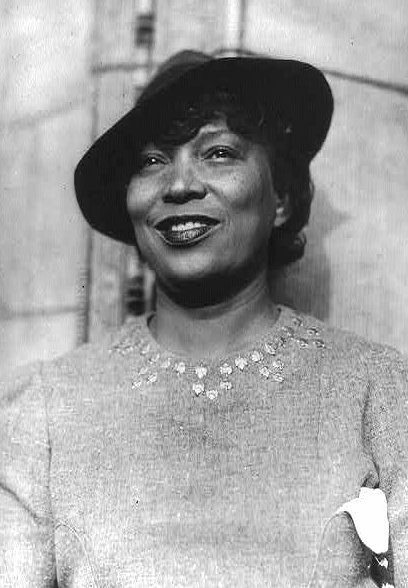
Zora Neale Hurston was born in Notasulga, Alabama on January 7, 1891. Both her parents had been enslaved. At a young age, her family relocated to Eatonville, Florida where they flourished. Eventually, her father became one of the town’s first mayors. In 1917, Hurston enrolled at Morgan College, where she completed her high school studies. She then attended Howard University and earned an associate’s degree. Hurston was an active student and participated in student government. She also co-founded the school’s renowned newspaper, The Hilltop. In 1925, Hurston received a scholarship to Barnard College and graduated three years later with a BA in anthropology. During her time as a student in New York City, Hurston befriended other writers such as Langston Hughes and Countee Cullen. Together, the group of writers joined the black cultural renaissance which was taking place in Harlem.
Throughout her life, Hurston dedicated herself to promoting and studying black culture. She traveled to both Haiti and Jamaica to study the religions of the African diaspora. Her findings were also included in several newspapers throughout the United States. Hurston often incorporated her research into her fictional writing. As an author Hurston started publishing short stories as early as 1920. Unfortunately, her work was ignored by the mainstream literary audience for years. However, she gained a following among African Americans. In 1935, she published Mules and Men. She later collaborated with Langston Hughes to create the play, Mule Bone. She published three books between 1934 and 1939. One of her most popular works was Their Eyes Were Watching God. The fictional story chronicled the tumultuous life of Janie Crawford. Hurston broke literary norms by focusing her work on the experience of a black woman.
Hurston was not only a writer, she also dedicated her life to educating others about the arts. In 1934, she established a school of dramatic arts at Bethune-Cookman College. Five years later she worked as a drama teacher at the North Carolina College for Negroes at Durham. Although Hurston eventually received praise for her works, she was often underpaid. Therefore, she remained in debt and poverty. After years of writing, Hurston had to enter the St. Lucie County Welfare Home as she was unable to take care of herself. Hurston died of heart disease on January 28, 1960. At first, her remains were placed in an unmarked grave. In 1972, author Alice Walker located her grave and created a marker. Although Hurston's work was not widely known during her life, in death she ranks among the best writers of the 20th century. Her work continues to influence writers throughout the world.
Discover More of Zora Neale Hurston’s Work:
-
Sweat - 1926; short story
Jonah’s Gourd Vine -1934
Mules & Men - 1935
Their Eyes Were Watching God - 1937
Tell My Horse - 1938
Moses, Man of the Mountain - 1939
Dust Tracks on the Road -1942
Seraph on the Suwanee - 1948
Every Tongue Got to Confess - 2001
Zora Neale Hurston The Complete Stories - 2008
Barracoon - 2018 *Finished writing in early 1930s, dismissed by publishers
-
The Making of Butterflies - Adapted by Ibram X. Kendi
Barracoon: Adapted for Young Readers - Adapted by Ibram X. Kendi
Magnolia Flower - Adapted by Ibram X. Kendi
Lies & Other Tales - Adapted by Joyce Carol Thomas
The Six Fools - Adapted by Joyce Carol Thomas
What’s the Hurry Fox & Other Animal Stories - Adapted by Joyce Carol Thomas
The Power of Our - Adapted by Ibram X. Kendi
The Skull Talks Back & Other Haunting Tales - Adapted by Joyce Carol Thomas
-
Mule-Bone: A Comedy of Negro Life - 1930 *with Langston Hughes
Cold Keener - 1930
De Turkey and De Law, a Comedy in Three Acts -1930
The Great Day - 1932; later revised as From Sun to Sun -1933
Spunk - 1935
Children’s Books About Zora Neale Hurston: